SHIELD Project
Syphilis rates in the United States (US) have reached their highest levels in decades, doubling in the past five years alone. The US syphilis epidemic is tied to HIV, with 25-50% of syphilis infections occurring among people with HIV (PWH). Both syphilis and HIV disproportionately affect racial, ethnic, and sexual minorities.
Despite the historical effectiveness of traditional methods, modern syphilis control in the US faces challenges due to the erosion of national infrastructure for combating sexually transmitted infections and the continued decline in public health budgets. This raises the question: "What are the most efficient and cost-effective strategies for investing in tools such as testing, partner services, and preventive counseling to curb the US syphilis epidemic?"
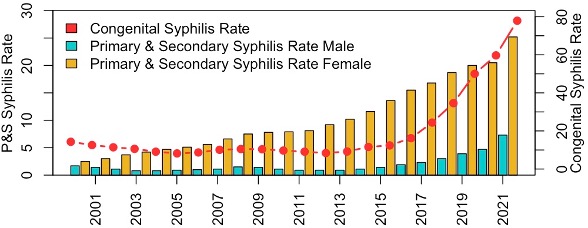
Figure 1: The resurgence of US Syphilis Epidemic (2001-2021)
Data Source: CDC
New innovative strategies, such as doxycycline for post-exposure prophylaxis ("doxy-PEP") and diagnostics like point-of-care (POC) or at-home testing, offer promise in reducing syphilis incidence. However, disparities in interventions' uptake can exacerbate existing racial and ethnic disparities in health outcomes. Thus, the question arises: "What are the most effective strategies for targeting emerging interventions at various subgroups, and what conditions would render these strategies both cost-effective and equitable?"
Supported by a 5-year grant from the National Institute of Allergy and Infectious Diseases (NIAID) [R01AI179776 PI: Kasaie], this study addresses a significant gap in representative models for the US syphilis and HIV epidemic by introducing a novel suite of Syphilis and HIV Integrated Epidemiologic and Economic Local-level Dynamics (SHIELD) models. These models will cover 32 US cities containing all Ending the HIV Epidemic (EHE) urban jurisdictions, comprising 60% of both syphilis and HIV diagnoses.
Research Aims
Aim 1: Existing Control Strategies
Assessing the impact and cost-effectiveness of expanding existing syphilis control strategies to reduce the burden and racial ethnic disparities in syphilis incidence, among PWH and the general population.
Aim 2: Emerging Strategies
Projecting the impact of emerging strategies on syphilis burden and disparities, and identifying the conditions under which these strategies would be cost-effective and equitable.
Aim 3: Decision Support Toolkit
Developing a policy support toolkit and framework for tailoring localized, cost-effective, equitable strategies to reduce syphilis among PWH and the general population.
Our Impact
Our findings will provide actionable insights and tools to support decision-makers in crafting effective responses to the syphilis and HIV epidemic, tailored to the specific needs and characteristics of their communities.